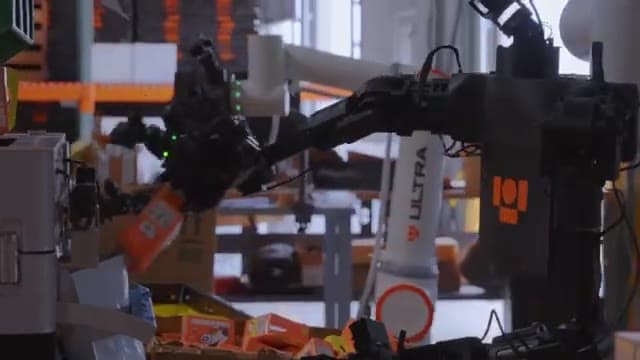
A two-armed robot bolts onto a stationary arm and packs orders in warehouses across the United States.
Its maker, Ultra, has raised more than $60 million, has a team of around 15 people, and charges $2,500 a month per robot.
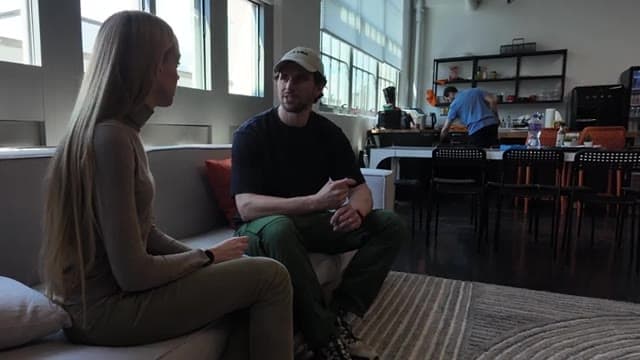
In Brooklyn, New York, Very Frontier founder India Jade toured the company with founder and CEO Jonathan Hurst, who started working on robots in high school and founded three companies in the past decade.
Hurst showed how the robots are built in-house, how remote pilots train the AI models that will replace them, and why warehouse operators are more comfortable with a stationary robot than with a humanoid that can be tipped over.
The Key Takeaways
Ultra's robot, Operator, packs e-commerce orders and can run 24/7 with no bathroom breaks and no phone checking.
Pilots operate the robots remotely from a different city, creating the training data behind a control AI Hurst compares to ChatGPT for robotic control.
One deployment has reached 97% autonomous runtime, meaning 19 out of 20 orders required no human intervention.
Ultra charges $2,500 a month flat fee per robot and believes it will beat general-purpose humanoids at stationary tasks.
A Full-Stack Robotics Company in Brooklyn
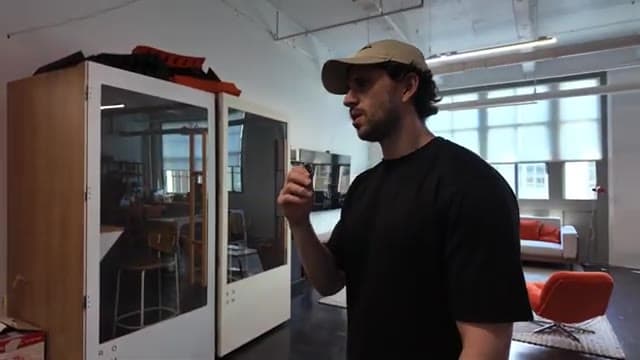
Ultra operates out of Industry City in Sunset Park, Brooklyn, across the street from its first customer.
The team builds the robots, writes the software, deploys them, and operates them for customers, a model Hurst calls full-stack robotics.
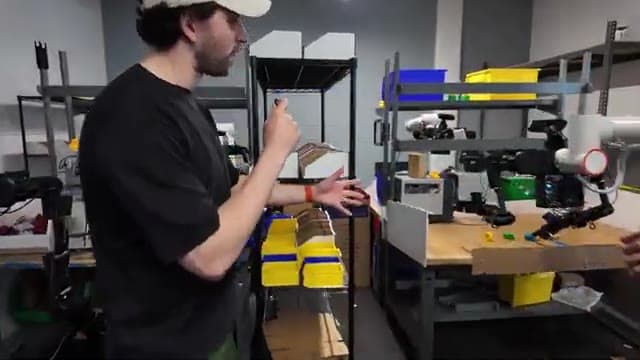
The lab holds seven robots running almost around the clock, a number set to reach 15, where the team tests hardware and AI models and generates training data.
Robots can currently be assembled at a rate of about one a day, and each one undergoes end-of-line testing before going out to customers.
The company initially built a sorting robot, moved on to an alpha version of Operator, and announced the current generation just before the visit.
Robots Learn Through Trial and Error
In the lab, robots stack rings on a peg over and over, generating data for experiments in online reinforcement learning.
The approach lets robots improve the more experience they have, learning through trial and error in the physical world.
Each robot has two arms and three cameras: a stereo egocentric camera allowing remote pilots depth perception in virtual reality, and cameras at each wrist.
While watching his daughters learn to do a handstand, Hurst realized watching demonstrates the mechanics, but real-world practice is what builds most skills.
Hurst says even the difference between now and six months ago has been large, and that is what makes him optimistic about the future.
The First Customer Came Before the Product
After a few months working out what the company would do, Ultra focused on logistics and e-commerce order packing.
Hurst and his co-founders met Richard, founder and CEO of e-commerce 3PL Highline Commerce, and convinced him to take a chance on Ultra before there was a product.
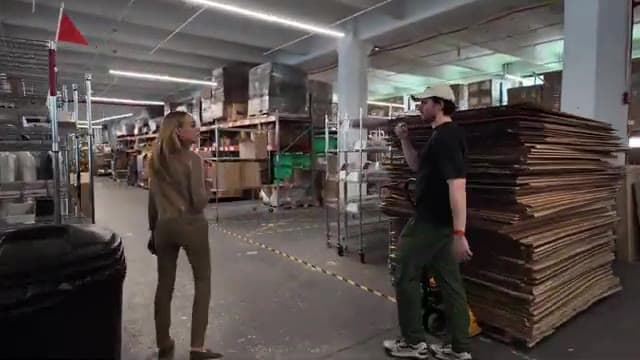
The team was based in San Francisco, but moved right across the street from Highline in New York.
In the early stages of a company, Hurst says you want the most possible access to your customers.
Today, Ultra has deployments across the United States packing real orders.
Pilots, Not Owners
At Highline Commerce, robots run one 8-hour shift a day (with more if the customer chooses), though Hurst says they can work 24/7.
Pilots work in a different city, controlling the robots in real time over video, viewing what the robot sees in VR.
Layering in autonomy is faster now: with a couple thousand hours of data, one deployment hit 97% autonomous runtime.
Hurst says over time the robot becomes mostly autonomous and each pilot does more.
Human-ish, Not Humanoid
Operator is human-ish in that it has two arms and a head that lets it look around, but that is where the resemblance ends.
Instead of legs or wheels, the robot is mounted on a stationary arm.
Warehouse companies have expressed concerns about the safety of legged or wheeled humanoids, which can be tipped over.
Hurst says so much work in a warehouse happens at a stationary desk, so Operator optimizes for that kind of task.
Ultra believes it will beat any general-purpose humanoid at these jobs, and plans to expand into sorting, kitting, and then tasks beyond warehousing like manufacturing and life sciences.
The Playbook After Three Startups
Hurst says it used to take hundreds of thousands or millions of dollars to build a very specialized robot for one use case, which made it hard to build a robotics company.
The breakthrough, in the AI era, is building one robot as a product and selling it again and again to different customers to do slightly different things.
Hurst built two factories with his previous company and used robots on repetitive tasks, but says they were brittle: something would move a millimeter and the whole system would stop.
With recent breakthroughs in AI for robotics, he decided to build the robots he wished he had, and started Ultra two years ago.
Hurst quotes Y Combinator co-founder Paul Graham on being told the key to succeeding is just to keep not failing.
He says great companies are not built because everything goes right, but by founders who stay with a problem long enough to understand something other people don't.